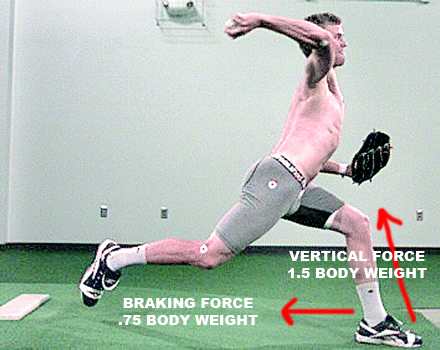
Comparison of High Velocity and Low Velocity Pitch Deliveries

June 18, 2009

Baseball ResearchStodden DF, Fleisig GS, McLean SP, Lyman SL, Andrews JR. Relationship of pelvis and upper torso kinematics to pitched baseball velocity. Journal of Applied Biomechanics 17(2):164-172, 2001.

Matsuo T, Escamilla RF, Fleisig GS, Barrentine SW, Andrews JF. Comparison of kinematic and temporal parameters between different pitch velocity groups. Journal of Applied Biomechanics 17(1): 1-13, 2001.

Stodden, DF, Fleisig, GS, McLean, SP, Andrews, JR. Relationship of Biomechanical Factors to Basebal Pitching Velocity: Within Pitcher Variation. Journal of Applied Biomechanics 21(1): 44-56, 2005 Read more

Popularity: 11%

Post to Twitter

Baseball Pitching Workout – Beginner

December 9, 2008

This is an excellent beginner workout. It focuses on training the body as a single unit. All these lifts support the development of Fast Twitch Muscle Fibers which will make you more explosive as an athlete. This workout was developed for pitchers but recommend for all positions. When starting this beginner program for the first time, make sure you keep your lifting weight down. Use the bar to start and once you gain confidence in your lifts, you can begin to add weight and use the percentages listed. Select the images below the workout of the lifts to view the instructional video. You can also view the Coach Gayle Hatch instructional videos here: Coach Hatch Videos to learn the lifts. Coach Gayle Hatch is a legend in the sports training world. He is most know as the 2004 USA Olympic Lifting Coach and was just named the World Coach for 2009. Some of the lifts do not have instructional videos. Search the web for exercises that would fill the role. Read more

Popularity: 52%

Post to Twitter

Pitching Velocity keys found in a car crash!

December 7, 2008

I am sure you are asking, “What does a car crash teach us about pitching velocity?” It actually teaches us pitchers everything we need to know, to truly understand, how pitchers generate top velocity. The reason for the correlation of the pitching delivery to the car crash, is the car crash analogy really helps us visualize the complex dynamics of momentum transfer. The reason for the complexity is because of the speed of the event. The moment in the delivery when momentum transfers into the ball to start its propulsion to the target, is as long as a split second. The problem is analyzing this event for educational purposes takes a lot longer. So this is where the car crash analogy will help us. Read more

Popularity: 24%

Post to Twitter

Lift for Show, Load for Doe!

November 22, 2008

Ok, the leg lift isn’t only for “Show.” There is a lot of momentum that can be generated by the leg lift which transfers into velocity. The question is, “How come pitchers who have big leg lift’s in the wind up, when pitching in the stretch, have a lower leg lift but still throw the same velocity?” The answer is called the “Load.”

“Loading” is when the pitcher holds his weight back over his back leg, while his front side continues building momentum towards the target. This is why strong legs and core, produce powerful pitching. Look at Eric Gagne in this picture. He is squatting on his back leg, waiting for the perfect time to fire his hips and then his shoulders. Read more

Popularity: 44%

Post to Twitter

5th and 6th Component of Pitching

October 26, 2008

All the photos here are of professionals performing the 5th and 6th Component of Pitching – Elbow Extension and Stabilization, as listed in the Ace Pitcher Handbook.

I do not own these photos. This is a collection I obtained from the web.
Read more

Popularity: 14%

Post to Twitter

Sprint Mechanics and the 40 yard Dash

August 24, 2008

by Chad Englehart

As a strength and conditioning professional one of the most prevalent questions we are asked is “Can I get my 40 yard faster and how fast can I be?” This question is easy to answer, for starters everyone can get faster because speed can be taught and how fast can an athlete become really depends on their genetic makeup. According to Brent McFarlane (1987) sprinting speed can be learnt through motor educability, he goes on to explain that the skills and techniques of sprinting must be rehearsed and perfected at slow speeds and then transferred to sprints at maximal velocity. Most of us know the definition of Read more

Popularity: 31%

Post to Twitter

How to Develop Top Velocity

June 21, 2008

To develop top velocity you must first understand it. Newton’s Second Law is the best definition of velocity. Read my article “Olympic Lifting Increases Pitching Velocity” to get a detailed description of Newton’s Second Law.
Read more

Popularity: 21%

Post to Twitter

Olympic Lifting Increases Pitching Velocity

June 12, 2008

To understand the effects of Olympic lifting on pitchers, you must first understand how velocity is measured. I will use Newton’s second law of motion, along with the Catapult Theory, to explain pitching velocity.

Newton’s Second Law:
States that the acceleration (velocity) of an object in motion is dependent upon two variables – the net force acting upon the object and the mass of the object. As the force of propulsion acting upon the object increases, the acceleration of the object increases. As the mass of the object increases, the acceleration of the object decreases.

Newton’s 2nd Law of Motion

a = f/m (f = force, m = mass, a = acceleration)

Let’s put this into baseball terms. Newton’s second law of motion would state that to throw a baseball 90 mph would require 6.5 pounds of pressure applied to a baseball, with a mass of 5 ounces, for two tenths of one second (.20). Read more

Popularity: 44%

Post to Twitter