

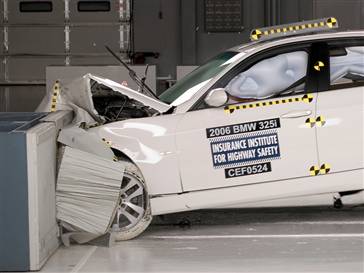
 Pitching velocity keys in a car crash? I am sure you are asking, "What does a car crash teach us about pitching velocity?" It actually teaches us pitchers everything we need to know to truly understand how pitchers generate top velocity.
The reason for the correlation of the pitching delivery to the car crash, is the car crash analogy really helps us visualize the complex dynamics of momentum transfer. The reason for the complexity is because of the speed of the event. The moment in the delivery when momentum transfers into the ball to start its propulsion to the target, is as short as a split second. The problem is analyzing this event for educational purposes takes a lot longer. So this is where the car crash analogy will help us.
In this article, you will learn pitching velocity keys that will define how important momentum is to pitching velocity and even more critical how important stopping this momentum is to pitching velocity.
Pitching Velocity Keys in Car Crash Analogy
To start the analogy to learn these pitching velocity keys we have a car, a hill and a wall. The car is sitting on top of the hill and the wall is built at the bottom. The wall is high enough to just peak over the hood of the car. There is a passenger in the car not wearing a seat belt. To begin, the car starts down the hill at full throttle. The farther it travels, the more speed it gains. It reaches the end of the hill and slams into the wall at full speed. The wall does not break or move. At this point I would like you to really visualize this event. I am sure you have a good enough understanding of classic physics to know what is going to happen to the passenger. Yes, the passenger is propelled through the windshield and flies through the air and lands about 40 feet in front of the car.
So, why did this happen? Yes, I could throw a bunch of scientific jargon at you but it shouldn't be this complicated. The passenger flies out of the vehicle after hitting the wall at full speed because it was the only part of the car that wasn't secured to it. Energy must go somewhere, so when the wall stopped the car, all the momentum transferred to the passenger because it still had the potential to move.
How does this relate to pitching? Good question! The best way for you to understand this comparison is if I describe the correlation. Let's start with the car. The frame of the car in the analogy of the car crash is the pitchers core. The hill is of course the pitching mound and the wall is when the pitchers front leg lands and stabilizes in his delivery. Now, the front leg is important in this analogy. It is playing the role of the wall. That is no easy role to fill because the wall, in this case, was able to stop the car dead in its tracks. So as the pitchers core travels down the hill, like the car, it gains momentum then the front leg lands and plays the role of the immovable wall.
What happens now? Let's continue to keep this simple. To understand what happens now we must label the last correlation of the car crash analogy. That being the passenger and .....What is playing the role of the passenger during the pitching delivery? I will tell you! The ball is the passenger. The ball is along for the ride like the passenger and it also is the only part of the ride that isn't secured to the vehicle or in this case, the pitcher. So, if the front leg does its job of playing the wall, then the ball will be forced to receive all of the momentum generated, in return reaching its top velocity potential.
You may still be a little confused at this point, so to help you pull it all together I will go into more detail about the wall. Let's bring back up the event of the car crash again. Let's say the car speeds down the hill and hits the wall but the wall does not hold. It gives away but manages to only slow the car some. What happens now to the passenger? The passenger does not fly through the windshield. This occurs because the wall didn't completely stop the car. It was allowed to continue moving until all the energy created from the inertia of the car dissipated. Therefore the passenger was saved because he wasn't forced to receive all of the momentum from the car. This will be the same case with the ball, if the wall or leg does not stabilize completely. This will mean the pitchers front leg will continue to bend instead of hold and the body will not transfer all of the momentum to the ball. For the pitcher to reach his top velocity potential he must stabilize from the front leg all the way up to the chin. The arm and ball should be the only part of the body moving after the chest has extended as far out as it is capable of going. Watch the video above of Edison Volquez performing this almost perfectly in the video above. Also view the pic here of Chien-Ming Wang in complete stabilization of his front side.
In conclusion, you should have learned that comparing high pitching velocity to a car crash really isn't a long stretch at all. It hopefully helped you learn some of the critical pitching velocity keys. Now here is the best program to train these pitching velocity keys.
The #1 BioMechanics Velocity Training Program
 This program has helped tons of pitchers live the dream of throwing 90+mph and signing with a D1 University, getting drafted by a Major League Organization and making it back to Major League Baseball. Many scouts in all organizations of baseball have recommended this program to help young pitchers get to the 90+mph range to improve their value at the next level.
The reason the 3X Extreme Pitching Velocity Program works is because it is based off of science and it has been proven to develop the 90+mph fastball on thousands of pitchers. It isn't rocket science or voodoo, it is the real deal! The program comes with a high level workload of drills, lifts and exercises scientifically programmed to enhance throwing speed on the mound while developing an efficient pitching delivery. The format of the 3X Pitching Velocity Program is similar to the same approach Olympic throwers have been using for decades to increase throwing velocity. This approach isn't new to the sports world but it is new to baseball.
If you are serious about your career and are insanely driven to put yourself into an extremely small percentage of pitchers who are potential D1 prospects, top level draft picks or you just want to reach your potential on the mound then this program is the best chance you have to making your dreams come true.
Learn more about the 3X Extreme Pitching Velocity Program or get started TODAY adding 5-10+mph!