

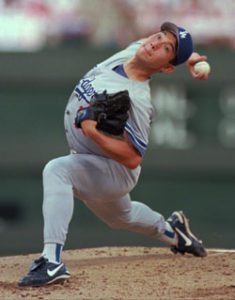
 I have already made the argument that the body generates the velocity of the pitch and not the arm. This article will continue to prove this point and give the pitcher a better understanding of how elite pitching velocity is generated.
This will challenge conventional wisdom, so please read with an open mind because you will learn that how baseball taught you to throw was backwards. I would also recommend that you do not share this with your coach because most coaches do not study this level of information, unfortunately.
In this article, I will give you two key case studies proving the arm does not generate the velocity and that the stretch shortening cycle is the link to elite pitching velocity.
Science Proves Elite Pitching Velocity is Not Created with Arm
Dr. Jobe FW, Dr. Tibone JE, Dr. Perry J, Dr. Moynes D performed a case study called An EMG Analysis Of The Pitching Shoulder. This study is the proof that the accelerator muscles in the arm do not fire when the arm is moving forward. Which means the arm muscles do not activate to generate the velocity of the pitch. Here is a summary of the study.
Five male subjects' throwing and pitching motions were analyzed by dynamic electromyography and high speed photography. Electrodes inserted into the deltoid and rotator cuff muscles attempted to define muscle activation patterns during the throwing and pitching cycle. The wind-up or preparation (Stage I) had no consistent pattern. Cocking (Stage II) had a sequential muscle activation pattern of first deltoid activity, followed by the S.I.T. muscles and finally by the subscapularis muscle. Acceleration (Stage III) had a lack of muscle activity, even though the arm was accelerating forward in space. Follow-through (Stage IV) was the most active stage with all the muscles firing intensely. The muscle patterns observed during the cycle were largely characteristic of attempts to decelerate the arm.
So if the accelerator muscles of the arm are not activated when the arm is moving forward then what is actually happening? The answer is elastic energy!
The Pitching Power of Elastic Energy
First, what is elastic energy? The best way to understand elastic energy is a rubber band. When you stretch a rubber band it builds elastic energy and this is the energy that launches it off of your finger, if you are shooting it at someone. A rubber band is very similar to a muscle. If you stretch a muscle like a rubber band, it also builds elastic energy. This is proven to be more effective in generating elite pitching velocity than just contracting the muscle for the same effect. The science behind this discover is called the Stretch Shortening Cycle(SSC). The definition as found on Wikipedia is, A stretch-shortening cycle (SSC) can be defined as an active stretch (eccentric contraction) of a muscle followed by an immediate shortening (concentric contraction) of that same muscle. This means, if you can stretch your accelerator muscles to initiate a contraction then you potentially can generate more pitching velocity in your fastball than just contracting the same muscles.
There is no better visual representation of elastic energy and the SSC than Hideo Nomo. This stretching for pitchers must occur after front foot strike when the shoulders begin to open and the arm is still cocked back. After front foot strike you must allow your momentum to thrust your chest forward while your arm is stretching back. This is where the SSC happens in the delivery. Now, before you stop reading this article and take off outside to try it out, you must understand more about how this SSC works. To understand this perspective and training approach even more, I will reference an article from the Journal of Orthopaedic & Sports Physical Therapy. You can read the article HERE.
The title of the article is Stretch-Shortening Drills for the Upper Extremities: Theory and Clinical Application. It was writen by, Kevin E. Wilk, PT', Michael 1. Voight, MEd, PT, ATC, SCS2, Michael A. Keirns, MA,, PT, ATC, SCS3, Vern Cambetta, MA4, lames R. Andrews, MD5, Charles 1. Dillman, PhD6.
The article starts by explaining that the SSC is only effective if the eccentric contraction is of short range and explosive.
The muscle's ability to use the stored elastic energy is affected by time, magnitude of stretch, and velocity of stretch. Increased force generation during the concentric contraction is most effective when the preceding eccentric contraction is of short range and is performed quickly without delay.
Research does support that the faster a muscle is loaded eccentrically, the greater the concentric force produced.
This is important to understand because when you first feel the results of the improved SSC in your own delivery you are going to want more. This means you are going to try and stretch it out more like Nomo in the pic above. This will only work against you because as the quote states above, the SSC is only effective if it happens quickly and by increasing the range of motion this could potentially slow down the explosiveness of the stretch shortening cycle. I do believe when learning something new it is better to over exaggerate. You will learn how to use the SSC quicker, if you overstretch this position, so you can feel the creation of more elastic energy. Later you can work on its efficiency and explosiveness.
Elastic Energy Pitching and the Catch
As with all good information there comes the catch. There is one mechanism in the body that will limit your potential to generating more elastic energy and it is called the golgi tendon. This tendon is located at the insertion of skeletal muscle fibers. This tendon is there to shut off the firing of the muscle if the tension becomes to damaging to the muscle fiber.
Since the golgi tendon organ serves as a protective mechanism limiting the amount of force produced within a muscle, its stimulation threshold becomes the limiting factor. Desensitization of the golgi tendon organ may be possible, thereby raising the level of inhibition and, ultimately, allowing increased force production with greater loads applied to the musculoskeletal system.
I believe that this desensitization of the golgi tendon occurs when your limits are pushed during training. This is another reason for performing a good strength and conditioning program that is sport specific and built around the SSC.
The implementation of the stretch-shortening program begins initially with the development of an adequate strength and physical condition base. The development of a greater strength base results in greater force generation as a result of both the increased cross-sectional area of the muscle and the resultant elastic component. In order to produce optimal strength gains, a structured plan must be instituted to prevent potential over-use injuries.
It has been the authors' clinical observation that patients performing stretch-shortening exercise drills have accelerated muscular performance gains compared with individuals who have not trained in this fashion.
The most significant contraindication to an intense stretch-shortening exercise program is non involvement in a weight training program.
This last quote from the article states the importance of a weight training program to not only increase the benefit of training with the SSC but that it is crucial to your health. This should be a wake up call to pitching coaches who preach against weight training to increase elite pitching velocity.
If you are sold on the mechanical and training approach of the Stretch Shortening Cycle then I would recommend you purchase the 3X Pitching Velocity program. The 3X program has a full medicine ball and strength training program that not only helps you develop more elastic energy in your delivery but it has a strength and conditioning program that supports it. Purchase it today and start gaining elite pitching velocity by developing more elastic energy through the SSC!
The #1 Elite Pitching Velocity Training Program
 This program has helped tons of pitchers live the dream of throwing 90+mph and signing with a D1 University, getting drafted by a Major League Organization and making it back to Major League Baseball. Many scouts in all organizations of baseball have recommended this program to help young pitchers get to the 90+mph range to improve their value at the next level.
The reason the 3X Extreme Pitching Velocity Program works is because it is based off of science and it has been proven to develop the 90+mph fastball on thousands of pitchers. It isn't rocket science or voodoo, it is the real deal! The program comes with a high level workload of drills, lifts and exercises scientifically programmed to enhance throwing speed on the mound while developing an efficient pitching delivery. The format of the 3X Pitching Velocity Program is similar to the same approach Olympic throwers have been using for decades to increase throwing velocity. This approach isn't new to the sports world but it is new to baseball.
If you are serious about your career and are insanely driven to put yourself into an extremely small percentage of pitchers who are potential D1 prospects, top level draft picks or you just want to reach your potential on the mound then this program is the best chance you have to making your dreams come true.
Learn more about the 3X Extreme Pitching Velocity Program or get started TODAY adding 5-10+mph!

http://www.biomedexperts.com/Abstract.bme/6829838…
very very clever, using a study from 1983 (a one time, "preliminary report" study from 26 years ago to try to prove a point). In fact, I believe it was the same study Dick Mills cleverly used/ dug up to try to support his point of view that the arm is inactive in the throw. Very clever, I must commend you for managing to find "science" to back your point of view.
Now, I'm not saying it's a bad cue to tell a player to think t use his body first to whip the arm, but i have a problem with the misinformation and dishonesty in trying to claim that the arm makes no active attempt to throw the ball. That is a flat out lie. Anybody can see a major league player is using his arm to throw the ball (in addition to the energy built up from his body). I think it's ludicrous that few people seem to have caught on to this.
I challenge you to find 3 more studies supporting this point of view, from the last 10 years. No, just one more study, from the last 10 years and done by different researchers that supports your argument. And post clips of throwers in your articles so people can decide for themselves if you're making sense.
Lankylefty I will take your challenge. Thanks for stopping by!
The excerpt from the book below called The Athlete's Shoulder written by Kevin E. Wilk, Michael M. Reinold, and James R. Andrews published in 2008 documents the shoulder activity by muscle and phase during baseball pitching. Table 32-1 clearly shows that the only accelerator muscle that increases its voluntary isometric contraction during the acceleration phase is the Triceps brachii. All the other accelerators maximum voluntary isometric contractions (MVIC) are occurring during the arm cocking phase. The book also states under the table that Gowan and colleagues demonstrated that muscle activity from the pectoralis major, supraspinatus, serratus anterior, and biceps brachii was approximately 50% greater in amateur pitchers compared with professional pitchers. From their data it can be concluded that better throwing efficiency by professional pitchers might require less muscle activity compared with amateurs. This is my point exactly. All of my points are based on comparisons between amateurs and professionals because everyone who reads my articles would more than likely like to be a professional one day. Thanks for the challenge my friend.
<iframe frameborder="0" scrolling="no" style="border:0px" src="http://books.google.com/books?id=fI5Nu030NqIC&lpg=PA385&ots=U7uG881UqP&dq=emg%20shoulder%20activity%20during%20pitching&pg=PA386&output=embed" width=500 height=500></iframe>
So your saying the golgi tendon limits how much force the muscle contracts by nerves but the study says it is not a voluntary firing contraction it is the elasticity of the muscle that makes it contract. The golgi could not limit the elastic effect because it wont change the properties of the muscle that makes it elastic. It acts like a resistor limits the voltage required to fire the muscle when the mechanical load gets larger which wont limit anything in elastic shorting because it is not firing. If the golgi senses overload while your muscle is contracting like a elastic it cannot stop it from contracting because that would mean your brain was telling it to contract.
I think you need to read the study again Diesel. The study says "The golgi tendon organ serves as a protective mechanism limiting the amount of force produced within a muscle, its stimulation threshold becomes the limiting factor." This means if the stimulation from the eccentric movement of the muscle fiber is overloading the golgi tendon then the tendon will limit the amount of force produced within the muscle. This will limit the amount of elastic energy produced because elastic energy is developed during the eccentric movement. The golgi tendons threshold is programed within the central nerves system, which would mean it is involuntary but has an effect on the elastic properties of the muscle fibers.
The muscle is firing but the contraction is an involuntary event. If the muscle fibers didn't fire during the stretch then the arm would rip off of the body.
Can you give me a quote from the link you listed above. The link only opens to the preview of the book.
Yes, the quote you quoted is correct but this is not supporting your argument. You are saying that during the Stretch Shortening Cycle the muscle fibers are not contracting. This is incorrect. Here is a quote from the article I posted above about the process of the SSC.
"The muscle spindle is provoked by a quick stretch, which reflexively produces a quick CONTRACTION of the agonistic and syneriistic extrafusal muscle fibers."