

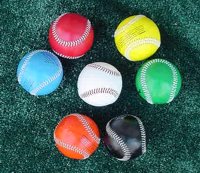
 Using the overload underload approach to train a young pitcher's arm increase arm speed is the right concept but the wrong approach when using weighted baseballs on a young pitcher. The problem is with using weighted baseballs on a young pitcher, who more than likely does not have the motor coordination of high velocity mechanics, is that it sacrifices the arm to teach the body how to move weight more efficiently and quickly. To understand how backwards this weighted baseball approach is for the young pitcher we must first look at what role the arm plays in the entire pitching delivery.
In this article, we will discuss the role the pitching arm plays in the high velocity delivery and how to best use weighted baseballs in a training approach for pitchers.
The Role of the Arm in the Pitching Delivery
The role of the arm is to get into position to allow for the transfer of energy from the lower kinetic chain into the upper kinetic chain. Once this energy has transferred through the core, from the stride power into hip to shoulder separation, then into the shoulder, during external rotation, the arm's role is to deliver the pitch to its desired location. Never does the arm work to generate pitching velocity on its own. It fires in reaction to the shoulder speeds that are the direct result of a power stride which converted into optimal hip to shoulder separation.
To better understand this sequence of events through the entire kinetic chain, which leads to the top velocity of the pitcher, you need to learn the revolutionary approach to pitching velocity called 3X Pitching. 3X Pitching proves that to increase the coil of the shoulder during external rotation the pitcher must first increase linear stride power and then transfer that power into core torque at front foot strike through optimal hip to shoulder separation. Working first on the arm speed with weighted baseballs may increase internal to external rotation speeds through conditioning but it will not support optimal hip to shoulder separation which has been proven to hold the majority of a high velocity pitchers pitching velocity potential.
Why Overload Underload with Weight Baseballs are NOT for Young Pitchers?
Based on the understanding of how pitching velocity is generated through the entire kinetic chain of the body stated above and also in the 3X Pitching approach, you can see that training with weighted baseballs, using an overload underload approach, should not be used with young pitcher's because it is only training the arm action of the entire delivery. It is not training the component, that the NPA proved in their 2005-2006 Velocity Study that 80% of velocity is generated from, which is hip to shoulder separation. Yes, this weighted ball approach may increase arm strength, using the weights, and may increase arm speed, through training the central nervous system to rotate the arm faster, but the final result will be much less effective for a young pitcher than taking a total body approach to velocity like with the 3X Pitching Velocity Program.
I used the Overload Underload weighted baseballs throwing program for years. It happened that I was using this program the year I torn my rotator cuff when I was a young pitcher. I am not saying that this program was the reason for my tear but it did speed up the process of the injury. My problem was I had bad mechanics. I was an all arm pitcher and when I used this program it made everything even worse. The overloading with the weighted baseballs put more wear and tear on my cuff and in the end, even if I had added a few mph, it wouldn't have been worth the extra wear and tear that came with it.
If you are looking to use weighted balls to increase pitching velocity, I really believe that you are looking for the easy answer here. Increasing pitching velocity is first developing yourself into a power athlete and then developing the motor coordination of power pitching mechanics like with the 3X Pitching mechanics. The 3X Pitching Velocity program gives you all of this with a revolutionary approach to increase pitching velocity. This approach uses the famous 3X Velocity System throwing program to develop the 3X Pitching mechanics and the famous Fusion System which is the strength and conditioning program to develop you into an elite power pitcher. So, stop looking for the easy way out and get serious with a pitching velocity program that actually teaches you high velocity mechanics like with 3X Pitching!
Safe Overload Underload Training Program
 This program has helped tons of pitchers live the dream of throwing 90+mph and signing with a D1 University, getting drafted by a Major League Organization and making it back to Major League Baseball. Many scouts in all organizations of baseball have recommended this program to help young pitchers get to the 90+mph range to improve their value at the next level.
The reason the 3X Extreme Pitching Velocity Program works is because it is based off of science and it has been proven to develop the 90+mph fastball on thousands of pitchers. It isn't rocket science or voodoo, it is the real deal! The program comes with a high level workload of drills, lifts and exercises scientifically programmed to enhance throwing speed on the mound while developing an efficient pitching delivery. The format of the 3X Pitching Velocity Program is similar to the same approach Olympic throwers have been using for decades to increase throwing velocity. This approach isn't new to the sports world but it is new to baseball.
If you are serious about your career and are insanely driven to put yourself into an extremely small percentage of pitchers who are potential D1 prospects, top level draft picks or you just want to reach your potential on the mound then this program is the best chance you have to making your dreams come true.
Learn more about the 3X Extreme Pitching Velocity Program or get started TODAY adding 5-10+mph!

I respect your opinions but it seems that is strictly what this article is – an opinion. I applaud your energy and attitude about helping others in this misinformed baseball world, but please show us what research has led you to your conclusions.
The weighted ball program you show in the picture is indeed a terrible program. You are only supossed to throw 20% of the orignal weight of a baseball – less or more. Basically meaning a 20% of a 5oz. ball is 1 oz. Consequently only work with a 4 oz ball and a 6oz balls during weight trainig. VDP (velocity development program) has an excellent SAFE weighted ball program. Google it.
Anything more than 6oz and less than 4 oz you are putting major stress on your shoulder capsule and can lead to serious injury (see: the author of this article).
"The underloading with the lighter ball gave me the illusion that I was throwing harder but it really is only an illusion. Just like the illusions of throwing harder when you move from throwing 300 feet to 60 feet."
Really? That is not why underloaded balls are used. Underloaded balls are used to train the tiny fast twitch muscles in your arm. Strengthening them does not directly make you throw harder. Instead, by strengthening your fast twitch micro-muscles your arm trusts itself to be thrown harder. Your brain will only accelerate your arm as fast as it knows it can decellerate it. AKA Your brain will only allow your arm to go as fast as it knows it can slow it down after you let go of the ball.
I've enjoyed your articles including long distance running, poor posture and scap loading. But please, before you advise uninformed kids to eliminate very beneficial weighted ball training (IF DONE WITH PROPER MECHANICS) please do research, talk to people. And read about the NPA (National pitching association), backed by Tom House a doctor with 40 years in baseball and has taught thousands of kids and hall of famers (Nolan Ryan, Greg Maddux, Randy Johnson, etc etc).
Let me know what you think…
Seth,
Thanks for the response to my article. I posted your email with my response on the forums so others can learn from this discussion.
http://discusspitching.com/viewtopic.php?f=29&t=9…
On the topic of the NPA o/u throwing protocol, I do incorporate these teaching methodologies in accordance to a strict adherence to proper throwing mechanics, appropriate age levels, and lastly in conjunction with a functional strength workout for the core, legs, and decelerating muscle groups. Our Velocity Development Camp runs a length of 7-8 weeks long, and has seen no less than an average of 4.2 mph increase in velocity. What has been more impressive is that our students are retaining their top velocities beginning the following season. It is not a magic bullet however. A marriage of all of the above mentioned components with proper nutrition and hydration practices will allow pitchers the greatest chance at reaching their genetic ceilings.
Your comment sounds too much like a guarantee on a diet pill.
“If you take our diet pills everyday, while eating a balanced diet and exercising 4-5 times a week for at least an hour each time, you will loss 5-10 pounds in a month!â€Â
You are rationalizing a program that has more hype than positive results. I agree with everything you say you do along with the u/o throwing program. I just believe the u/o throwing program will cause more harm than good.
Brent,
Hype is placed on this program by misinformed coaches who have the audacity to use this as a sole method of gaining velocity. It is used as one component of my program. Maybe in 10 years we'll have more data and be able to definitively prove either positively or negatively what the program holds. As for now, I have quantified results from injury-free pitchers that utilized the program, and I believe the o/u played at least a small part of their successes. Keep up the good work on your website.
Hey coach Brent, I was just checking out your website. I think it has some pretty interesting thing.
Thanks,
Rick Ragan
ASMI says overload and under load works….and your still not for it?
Michael, actually this is a quote from ASMI's Dr. Glenn Feisig on this topic:
"The bottom line is that the research seems to point to using underweight and overweight balls that are only slightly lighter or slightly heavier than the normal ball. Specifically for baseball, stay between 4 oz and 6 oz balls. (A standard baseball is 5 oz.)
If you want to use a significantly heavier or lighter ball, you will not be using proper baseball pitching mechanics. Therefore, ASMI's recommendation is to avoid these type of balls in-season, as you may mess up your pitching mechanics. Using very light or very heavy balls out of season may have benefit, as you can develop general athleticism and fitness."
I believe that the more ASMI studies this approach the more they will not advise it. This is why I stand with my opinion on overweight to underweight ball training.
no no, I never meant to use heavier balls than 20% rule. I ordered a 4oz and a 6oz all I will use besides a football
I promise you using these drills alone will not help you reach your velocity goals. You need a program that trains and coaches all facets of the power pitcher. For example: mechanics, nutrition, strength and conditioning, anaerobic training, etc…
I know that, just like adding a supplement to a stack, its just a staple that will help.