

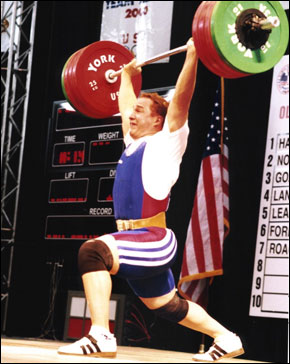
 So the question is does Olympic Lifting Increases Pitching Velocity? Both Olympic Lifting and Pitching Velocity are NOT on different ends of the spectrum of sports as conventional wisdom would have you believe. Specifically Olympic Weight Training and Velocity are both closely related and this article will help explain how and why.
To understand how Olympic Lifting Increases Pitching Velocity, you must first start with basic physics. I will use Newton's second law of motion, along with the Catapult Theory, to explain pitching velocity.
Newton's Second Law:
States that the acceleration (velocity) of an object in motion is dependent upon two variables - the net force acting upon the object and the mass of the object. As the force of propulsion acting upon the object increases, the acceleration of the object increases. As the mass of the object increases, the acceleration of the object decreases.
Newton's 2nd Law of Motion
a = f/m (f = force, m = mass, a = acceleration)
Let's put this into baseball terms. Newton's second law of motion would state that to throw a baseball 90 mph would require 6.5 pounds of pressure applied to a baseball, with a mass of 5 ounces, for two tenths of one second (.20).
6.5 pp applied to a 5 ounce baseball for .20 seconds = 90 mph fastball
Therefore to increase an 80 mph fastball to 90 mph you must either increase the force applied or the application time. The application time is how long you hold on to the ball once the force is applied. Subtracting 25% of application time forces a pitcher to increase the applied force by 33%. Increasing the application time by 10%, increased to .22 seconds, would add 10 mph to an 80 mph fastball.
80 mph fastball + 10% more application time = 90 mph fastball
* If you desire to see the formula in more detail that explains Newton's Second Law defining the velocity of a baseball in motion then refer to Dr. Mike Marshalls article at: www.drmikemarshall.com/ChapterTwenty-Nine.html To find info scroll down to "1. The Release Velocity Formula for Baseball Pitchers."
Catapult Theory:
 The Catapult is made up of three components: the pivot, the coil and the arm. Let's add a ball to the end of the arm to represent a baseball. To measure the velocity of the baseball, after the arm is released and the ball is in motion, we use Newton's second law as described above. The importance of the Catapult is its relation to a pitcher at his full range of motion before launch of ball (See picture of Nolan Ryan below). If the Catapult pivot is not stable and is moving forward during release of the arm, then this will decrease the force applied to the ball at launch. In return, poor velocity. Now, if we stabilize the pivot, meaning no movement, and continue to apply the same force to the ball. When the arm is released and the ball is launched, it will reach its potential velocity. To keep force applied to the ball consistent the coil must maintain pressure on the arm during the entire delivery process.
How does Olympic lifting come into this equation?
 First reason, it is the only type of lifting in the weight room that trains triple extension.
What is triple extension? This isn't something new to the sports world. Olympic lifters have been using the term "Triple extension" for a long time. Triple extension occurs when the ankle joint extends, the knee joint extends along with the extension of the hip flexor. Visualize a long jumper in mid air like above (Notice left leg in triple extension). Also notice, in the picture to the right of Nolan Ryan, his right leg has triple extension. You can see his ankle, knee, and hip flexors in full extension. There is no weight lifting that trains the body pushing off of the ground as a single unit better than the Olympic Lifts. Triple extension plays in every sport that involves pushing off of ground.
Second reason, notice the lifter doing a split jerk at the top of the article. This is a very similar movement to pitching. More similar than any other weight training exercise. Studies have shown that athletes get better when training within their sport. This is called sport specific training.
This lifter is using triple extension to drive the weight up. Just like the pitcher driving the ball to the plate. The only difference here is the consequence of error. If the lifter losses momentum in the hips, he will drop the weight. If the pitcher losses momentum in the hips, he will throw a home run to some lucky batter.
If you want to learn about the Olympic Lifts and what they are, follow this link and watch the instructional video.
Coach Gayle Hatch Instructional Videos.
Now, how does triple extension increase velocity?
In all ways described in the Catapult theory above and Newton's Second law, it adds both application time and force applied to ball.
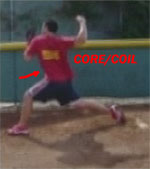 First let's explain how it increases application time, which is the most efficient way to increase velocity. Maximum application time comes from full range of motion. Example, Nolan Ryan has 180 degrees range of motion in picture above. This is the maximum possible. This means the Catapult is set to its potential, arm all the way back. For this to occur with a pitcher the hips must be pushed under the shoulders. The only way to push the hips under the shoulders is extending the back leg ankle, knee and hip flexor, also called Triple Extension, at the perfect time. With hips all the way under the shoulders, the pitcher now has reached his full range of motion, therefore increasing the application time to build or maintain force to the ball.
If the hips are lagging, the chest is leaning forward and the arm is leading the body, then minimal application time has occurred. Less range of motion therefore less potential to create more velocity.
Triple extension adds force to the ball because it aids in the momentum originally generated from the lift leg along with gravity. This only aids the momentum, if triple extension occurs, just before front foot strike. If it happens to early and the hips have not moved down the mound, then the hips open too soon. This kills the purpose of good momentum and it also kills full range of motion.
With chest out and hips under shoulders, chest and chin must remain up until launch of ball to keep pivot stable through entire delivery.
More ways Olympic Lifting Increases Pitching Velocity!
Not only do these lifts train Triple Extension better than any other style of lifting but it specifically trains fast twitch muscle fiber. This is what makes an athlete explosive. For pitchers and baseball players, getting stronger in the weight room has been forbidden, until the steroid area came into fruition. Now everyone is lifting. This isn't a trend. This is because it works!
The final way Olympic Lifting Increases Pitching Velocity occurs during stabilization of the front leg. Like described in the Catapult Theory, stabilization must occur to prevent decreasing force applied to ball. Therefore if the pitchers landing leg moves forward or gives away, then force is decreased to the ball. In return poor velocity. Notice Nolan Ryan in the picture here. His front leg almost triple extends. This means he is preventing instability in his front leg by holding and even extending it back into his hips. This is why he reached his top velocity.
So how do I get started?
 In the weight room but first find a professionally certified Olympic Lifting Coach. These lifts take a lot of training to perform correctly, so to prevent injury. I do not recommend performing these lifts with out a proper coach supporting you. Please check with your physician before performing these lifts and remember weight is not important. Your form in the weight room and on the field is all that matters. Always sacrifice weight for good mechanics.
If you have any questions about this information please post your questions on the discussion board.
Weight Training and Velocity
Olympic lifting isn't the only lifts in the weight room that will enhance performance and increase pitching velocity. They are the best lifts in the weight room for velocity but not the only ones. The Fusion system, which is the strength and conditioning program in the 3X Pitching Velocity program, includes the Olympic Lifts but also other effective lifts and exercises in the weight room for increasing velocity.
Thanks for reading this article on Olympic Lifting Increases Pitching Velocity. Please share!
Trackbacks/Pingbacks