

 To develop top pitching velocity you must first understand the science behind it. Newton's Second Law is the best definition of velocity. Read my article "Olympic Lifting Increases Pitching Velocity" to get a detailed description of Newton's Second Law and how it relates to pitching velocity.
It is a major challenge to take the scientific definition of velocity and put it into motion within the pitching delivery. The only way I made this happen was through constant trial and error.
Before I give you the secrets to top pitching velocity you must first understand how important it is to train the body for this ability. Your training program should be made of lifts and drills that are enhancing power production while remodeling fast twitch muscle fibers. I am sure you have heard me say this a million times on this site but there is no better training method than the Olympic Lifts when it comes to enhancing power and remodeling fast twitch muscle fibers. This involves all types of Cleans, Snatches, and Split Jerks. These lifts force you to move a good amount of weight very quickly, therefore making you a more explosive athlete. Once you have maxed your explosive potential as an athlete, you are then ready to achieve your top velocity as a pitcher.
In layman's terms velocity as defined by Newton is force divided by mass, so for you to develop more velocity, you either need to increase the force applied to the ball or the application time with the same amount of force. I recommend we do both as pitchers.
First Component to Develop Top Pitching Velocity
The first component is increasing force to ball. This may seem complicated but in theory it is very simple, so stay with me. To increase force to the ball we must add momentum to our delivery and then stabilize that momentum for transfer to ball. Now, this is where most young pitchers go wrong. Most young pitchers when trying to add force to the ball, only add the momentum to the arm. Momentum must be added to the entire body if we are going to significantly effect velocity. Let's use a Javelin thrower to understand how to increase force through the entire body. What a Javelin thrower does is he runs as quick as he can to a point where he must plant his front leg to stop his momentum, by stopping his momentum with his lower half this allows it to transfer up his kinetic chain into the Javelin. Watch the video!
A Pitcher is not allowed to run to develop the momentum, so the pitcher must do whatever he can to develop the momentum on the mound starting in a static position. The key to a pitcher maxing out his bodies potential to generate his top speed or momentum starting in a static position is through a key component to increase pitching velocity. This component is called Triple Extension. To learn more about this key component to pitching velocity, read the article I linked above called, Olympic Lifting Increases Pitching Velocity or continue reading this site and learning the 3X approach to pitching velocity.
Second Component to Develop Top Pitching Velocity
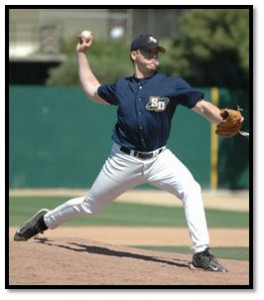 The second component is to increase application time. Application time means the amount of time a pitcher holds on to the ball through his full range of motion.
If a pitcher applied 6.5 pounds of pressure to the ball, for .20 seconds, as the arm is moving towards the target, this would have more velocity than a pitcher applying 6.5 pounds of pressure to the ball for .15 seconds.
The question now is how do we hold on to the ball longer while keeping the same force applied. This answer is Separation and External Rotation. Separation is illustrated in the picture here of me in my playing days. Notice that my arm is cocked back to second base while my hips are almost pointing towards the target. This is separating my hips from shoulders which is building torque. More torque means more range of motion, along with more elastic energy, to build force. Once my shoulders fire then my arm will stay relaxed and move into external rotation, which is now building range of motion in the shoulder along with torque, like in a catapult system. These two key components have increased application time along with more force applied to increase pitching velocity.
In conclusion, developing top pitching velocity is every pitcher's right but not every pitcher has the natural understanding of this skill. With this article, the 3X Pitching Velocity program and some hard work, it is possible for any pitcher to reach their top velocity.
This is really a great article. I wish I was taught all of this stuff when I was younger. I'm trying to get back into pitching now for my team and I know I wouldn't be able to if I didn't read this article. Now I have a chance haha.
Brent, how do i purchase the AcePitcher Handbook? We have been throwing the football bs both boys are quarterbacks and they do the olympic lifting in football as well with the supervision of the coaches at school. As soon as 2 a days are over we want to start working with some pithcing exercises to get ready for spring and summer baseball. thanks mike
You can purchase the AcePitcher Handbook now at http://www.AcePitcher.com.
what type of med ball drills, promote pitching velocity?
The 3X Med Ball drills in the 3X Pitching Velocity Program.